

Munchkin
The Munchkin is a cat breed with naturally short legs caused by a dominant genetic mutation — the same limb-shortening gene that produces dachshunds and corgis in dogs.
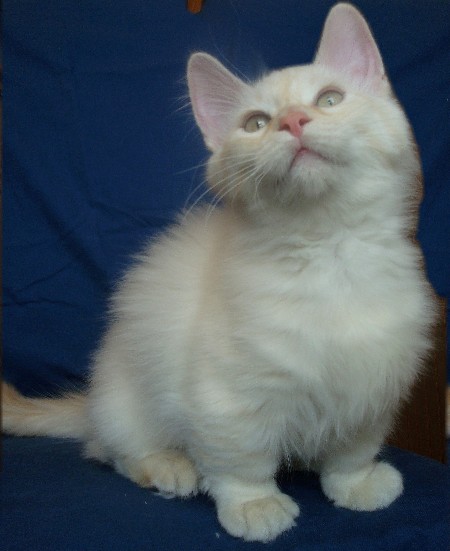
Photo: Wikimedia Commons
Origin
United States
Lifespan
12–15 years
Weight
2.5–4 kg (5.5–9 lbs)
Height
15–20 cm (6–8 in) — body height significantly reduced by short legs
Exercise
10 to 20 min/day
Diet
Obligate carnivore — high-quality wet and dry food. Small body; monitor weight carefully as obesity puts additional strain on short limbs.
Taxonomic Hierarchy
Kingdom
Animalia
Phylum
Chordata
Class
Mammalia
Order
Carnivora
Family
Felidae
Genus
Felis
The Story
The Munchkin is a cat breed with naturally short legs caused by a dominant genetic mutation — the same limb-shortening gene that produces dachshunds and corgis in dogs. The founding cat, a pregnant stray named Blackberry discovered in Louisiana in 1983, passed the short-leg gene to half her kittens. The breed is controversial — the CFA does not recognise it due to ethical concerns about deliberately breeding for a structural abnormality, and it is banned from competition by GCCF and FIFe. Despite this, Munchkins are popular pets and are generally healthy, though spinal problems are monitored carefully.
Also Known As
Quick Facts
Discover which pets match your lifestyle
Physical Profile
Source: wikimedia
The Munchkin has a normal cat body — average length, chest, and head — supported on very short legs (roughly one-third the length of a typical cat's legs). The short leg gene is dominant and lethal when homozygous — all Munchkin-to-Munchkin breedings produce some normal-legged kittens. Both shorthaired and longhaired varieties exist. The body is well-muscled and surprisingly agile despite the short legs.
Grooming
Low
Shedding
Moderate
Coat Length
short
Coat Type
smooth
Brushing
1-2x-Weekly
Bathing
Rarely
Coat Colors
Recognized By
Source: wikimedia
Temperament & Personality
Munchkins are outgoing, confident, and playful — they appear unaware of their shortened stature. They run, jump (lower than average cats but still effectively), and play with full energy. They are sociable and get on well with children and other pets.
Personality Scores
Adaptability
5/5Attention Need
4/5Friendliness
5/5Playfulness
4/5Protectiveness
1/5Living Profile
Ideal Space
Apartment
Daily Exercise
10 to 20 min/day
Ideal Weather
10°C to 28°C
Indoor/Outdoor
Indoor-Only
Cognitive Benchmarks
Adaptability
50%
Attention
40%
Playfulness
40%
Communication Style
Vocal Profile
quiet
Stress Signals
hiding, litter box avoidance, appetite loss, reduced mobility
Care & Wellness
Professional Care Protocol
- •Same basic care as other shorthaired cats. Monitor weight carefully — obesity puts additional strain on already-shortened limbs and spine. Avoid high drops that could stress joints. Regular spinal health monitoring by a vet.
Nutrition Notes
ETHICAL CONCERN: Lordosis (spinal curvature) and pectus excavatum from dwarfism gene. Obesity dangerous to short legs. Strict portions.
Vaccination Schedule
Vaccination Schedule
Senior Care
Lordosis (spinal curvature). Pectus excavatum (chest deformity). Osteoarthritis. The dwarfism gene is a form of achondroplasia — several countries considering breeding bans. NEVER breed Munchkin × Munchkin (lethal combination). Controversial breed. 12-15 years.
Wellbeing Activities
Nutrition & Sustenance
Daily Calories (Adult)
350 kcal
Daily Calories (Young)
250 kcal
Recommended Foods
Foods to Avoid
Health Overview
The short-leg gene causes lordosis (spinal curvature) in some individuals. Spinal problems are monitored in the breed. The homozygous (Mk/Mk) genotype is lethal — all Munchkin litters contain normal-legged kittens. HCM. Joint stress from shortened limbs monitored in older individuals.
Common Conditions
Price Estimates
Pricing Guide
Average estimates as of 2025
ETHICAL: Dwarfism gene causes spinal issues. Several countries considering bans. NEVER breed Munchkin × Munchkin (lethal).
Purchase Price
$800 to $2,500
Adoption Fee
$75 to $350
Data from 2025
Fun Facts
The Munchkin's short-leg mutation is a dominant gene — unlike the Manx tailless gene (which is lethal when homozygous), Munchkin cats always carry one copy of the gene and one normal copy. Homozygous Munchkin embryos do not survive.
Despite short legs, Munchkins are fast runners and reasonably effective jumpers — they compensate for reduced height by developing powerful hindquarters. They are particularly noted for sitting upright on their haunches (a position also called the "Munchkin sit") to observe their surroundings.
The Munchkin is the foundation breed for several "designer" crossbreeds — the Bambino (Munchkin × Sphynx), Kinkalow (Munchkin × American Curl), and Lambkin (Munchkin × Selkirk Rex) are examples of Munchkin-derived breeds.


