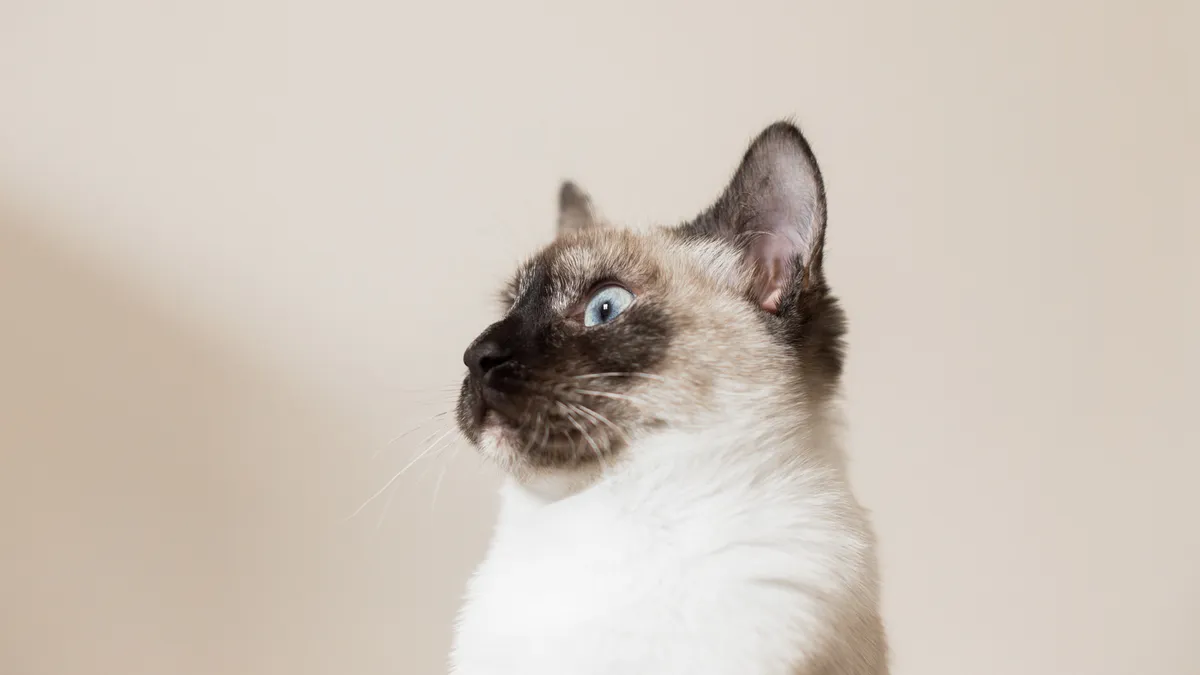

Siamese
The Siamese is one of the oldest and most recognisable cat breeds in the world — an ancient natural breed from Thailand (formerly Siam) that has been documented in Thai manuscripts (the Tamra Maew or "Cat Poems") dating to the 14th century.
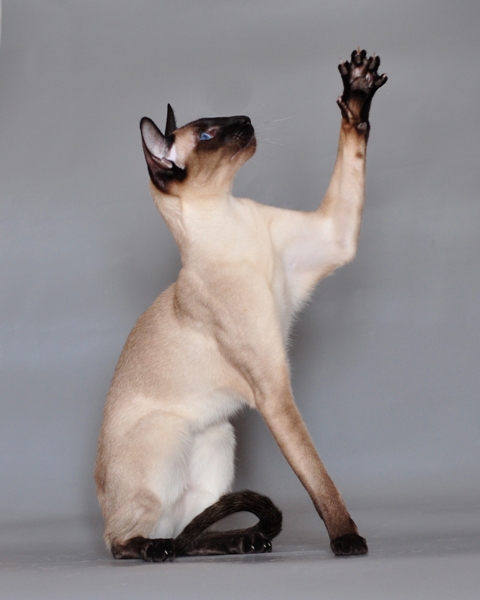
Photo: Wikimedia Commons
Origin
Thailand
Lifespan
15–20 years
Weight
3–5 kg (6.5–11 lbs)
Height
23–33 cm (9–13 in)
Exercise
20 to 30 min/day
Diet
Obligate carnivore — high-quality wet and dry food; generally good eaters but monitor weight as obesity can develop with indoor-only sedentary lifestyle.
Taxonomic Hierarchy
Kingdom
Animalia
Phylum
Chordata
Class
Mammalia
Order
Carnivora
Family
Felidae
Genus
Felis
The Story
The Siamese is one of the oldest and most recognisable cat breeds in the world — an ancient natural breed from Thailand (formerly Siam) that has been documented in Thai manuscripts (the Tamra Maew or "Cat Poems") dating to the 14th century. The Siamese arrived in Britain as a gift from the King of Siam to the British Consul-General in 1884, and its distinctive pointed colouration and extraordinary voice immediately made it a sensation. The Siamese is the ancestral breed from which many modern breeds were developed — the Balinese, Oriental Shorthair, Tonkinese, and Burmese all descend from Siamese ancestry.
Also Known As
Quick Facts
Discover which pets match your lifestyle
Physical Profile
Source: wikimedia
The modern Siamese is a cat of extreme elegance — long, tubular body, long slender legs, wedge-shaped head with large triangular ears, and almond-shaped brilliant blue eyes. The coat is short, fine, and close-lying. The defining characteristic is the colourpoint pattern — dark "points" (face mask, ears, legs, and tail) contrasting with a pale body, caused by a temperature-sensitive enzyme that produces pigment only in the cooler extremities. The Traditional (Applehead) Siamese has a rounder, more moderate head and body.
Grooming
Low
Shedding
Low
Coat Length
short
Coat Type
smooth
Brushing
1x-Weekly
Bathing
Rarely
Coat Colors
Recognized By
Source: wikimedia
Temperament & Personality
Siamese are famously vocal — they have an exceptionally loud, low-pitched voice that they use constantly to communicate with their owners. They demand attention, companionship, and mental stimulation. They are highly intelligent and can learn to open doors, operate taps, and perform complex tricks. They form intense bonds with their primary person and can develop separation anxiety when left alone. They should ideally be kept in pairs.
Personality Scores
Adaptability
4/5Attention Need
5/5Friendliness
5/5Playfulness
5/5Protectiveness
2/5Living Profile
Ideal Space
Apartment
Daily Exercise
20 to 30 min/day
Ideal Weather
15°C to 30°C
Indoor/Outdoor
Indoor-Preferred
Cognitive Benchmarks
Adaptability
40%
Attention
50%
Playfulness
50%
Communication Style
Vocal Profile
loud
Stress Signals
excessive vocalisation, pica (wool sucking/eating), over-grooming (psychogenic alopecia), aggression, spraying
Care & Wellness
Professional Care Protocol
- •The short coat is very low maintenance — weekly brushing is sufficient. The primary care need is social: Siamese need daily interaction and should not be left alone for long periods. A companion cat (ideally another Siamese) prevents separation anxiety. Regular dental care important. Annual vet check of eye health.
Nutrition Notes
Amyloidosis (liver) is breed-specific — protein quality matters. Generally lean, athletic build. Dental disease (gingivitis/stomatitis) common — dental-specific food helps. Pica (eating non-food items like wool) is breed-predisposed.
Vaccination Schedule
Vaccination Schedule
Senior Care
Amyloidosis (liver) — breed-specific. Progressive retinal atrophy (PRA). Convergent strabismus (cross-eyed — cosmetic, not harmful). Asthma/bronchial disease elevated. Mammary tumours. Pica may worsen with stress. Colourpoint is temperature-sensitive (darker at extremities). One of the longest-lived breeds (15-20 years). Documented in Thai Tamra Maew manuscripts (14th century).
Wellbeing Activities
Nutrition & Sustenance
Daily Calories (Adult)
350 kcal
Daily Calories (Young)
250 kcal
Recommended Foods
Foods to Avoid
Health Overview
Amyloidosis (abnormal protein deposits in organs, particularly liver) is a Siamese-specific concern. Progressive retinal atrophy (PRA) with a DNA test available. Hypertrophic cardiomyopathy (HCM). Convergent strabismus (crossed eyes) and nystagmus (repetitive eye movement) are historical traits that have been largely bred out but still occur. Dental disease is elevated. Some Siamese-related lines have elevated rates of intestinal cancer.
Common Conditions
Price Estimates
Pricing Guide
Average estimates as of 2025
Modern (wedge-head) vs Traditional (apple-head/Thai) — two distinct looks. NEVER leave alone — separation anxiety is severe. Get a pair. India: good climate fit (Thai origin).
Purchase Price
$600 to $2,000
Adoption Fee
$50 to $300
Data from 2025
Fun Facts
The Siamese's colourpoint pattern is temperature-sensitive — kittens are born entirely white and develop their points as they cool after leaving the warm womb. A Siamese that undergoes surgery or has a shaved area may develop darker fur there temporarily due to the cooler skin temperature.
The Siamese is the ancestral breed of a remarkable number of modern cat breeds — the Balinese, Oriental Shorthair, Oriental Longhair, Tonkinese, Snowshoe, and parts of the Burmese breeding programme all trace back to Siamese.
In the Thai manuscript "Tamra Maew" (Cat Book Poems), estimated to be from the Ayutthaya Kingdom (1351–1767), the Wichianmat (Siamese) is described as one of the most auspicious cat breeds — a cat that brings good fortune to its owner.
The Siamese voice is unique — their loud, insistent call is often compared to a baby crying and has been used as evidence in noise complaints against owners.