

Manx
The Manx is one of the most ancient and recognisable cat breeds — a naturally tailless cat from the Isle of Man in the Irish Sea.
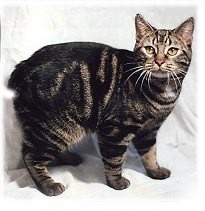
Photo: Wikimedia Commons
Origin
United Kingdom
Lifespan
14–16 years
Weight
3.5–5.5 kg (8–12 lbs)
Height
23–30 cm (9–12 in)
Exercise
10 to 20 min/day
Diet
Obligate carnivore — high-quality wet and dry food. Monitor weight.
Taxonomic Hierarchy
Kingdom
Animalia
Phylum
Chordata
Class
Mammalia
Order
Carnivora
Family
Felidae
Genus
Felis
The Story
The Manx is one of the most ancient and recognisable cat breeds — a naturally tailless cat from the Isle of Man in the Irish Sea. The taillessness results from a dominant genetic mutation that has been present in the island's cat population for centuries, possibly since a tailless cat arrived by ship and spread the gene through the isolated island population. Four tail types exist in the breed: "rumpy" (completely tailless), "rumpy riser" (a small knob of fused vertebrae), "stumpy" (a short stub tail), and "longy" (a near-normal tail). Only rumpies and rumpy risers are shown in CFA competition.
Also Known As
Quick Facts
Discover which pets match your lifestyle
Physical Profile
Source: wikimedia
The Manx has a distinctive profile — the rump is higher than the shoulders (due to the absence of tail vertebrae and elongation of the back legs), the back is short and rounded, and the overall appearance is rounded and cobby. The double coat is thick and dense. The most notable feature is the absence of a tail in the most prized "rumpy" variety — the rump is rounded and smooth where a tail would normally be.
Grooming
Low
Shedding
Moderate
Coat Length
short
Coat Type
plush
Brushing
1-2x-Weekly
Bathing
Rarely
Coat Colors
Recognized By
Source: wikimedia
Temperament & Personality
Manx are gentle, playful, and dog-like — they follow their owners, can be trained to fetch, and form strong bonds. They are good with children and other pets. They often develop strong bonds with one person. They are more active than their round appearance suggests.
Personality Scores
Adaptability
4/5Attention Need
3/5Friendliness
4/5Playfulness
4/5Protectiveness
2/5Living Profile
Ideal Space
Apartment
Daily Exercise
10 to 20 min/day
Ideal Weather
5°C to 25°C
Indoor/Outdoor
Indoor-Preferred
Cognitive Benchmarks
Adaptability
40%
Attention
30%
Playfulness
40%
Communication Style
Vocal Profile
quiet
Stress Signals
hiding, litter box avoidance (may indicate spinal issues), appetite loss
Care & Wellness
Professional Care Protocol
- •The double coat requires brushing 1–2 times weekly. The rounded rump should be checked for any signs of spinal discomfort. NEVER breed rumpy-to-rumpy — homozygous Manx kittens die in utero or shortly after birth ("Manx syndrome").
Nutrition Notes
Manx syndrome (spina bifida) — tailless gene can cause fatal spinal defects. NEVER breed Manx × Manx. Joint supplements. Arthritis from spinal issues.
Vaccination Schedule
Vaccination Schedule
Senior Care
Manx syndrome (spina bifida, bowel/bladder issues) — the tailless gene IS a spinal defect gene. Arthritis. Corneal dystrophy. Rumpies (no tail) highest risk. Stumpies/longies healthier. Isle of Man origin. 8-14 years.
Wellbeing Activities
Nutrition & Sustenance
Daily Calories (Adult)
380 kcal
Daily Calories (Young)
280 kcal
Recommended Foods
Foods to Avoid
Health Overview
Manx syndrome — the tailless gene, when homozygous, causes severe spinal defects including spina bifida and absent bowel and bladder control. This is why responsible breeders never breed rumpy-to-rumpy. Even heterozygous Manx may develop spinal issues. Arthritis of the shortened spine in older individuals. Corneal dystrophy in some lines.
Common Conditions
Price Estimates
Pricing Guide
Average estimates as of 2025
NEVER breed Manx × Manx. Rumpies (no tail) have highest health risk. Isle of Man.
Purchase Price
$600 to $2,000
Adoption Fee
$50 to $300
Data from 2025
Fun Facts
The Manx tailless gene, when homozygous (both copies present), is lethal in utero — Manx kittens are always heterozygous, meaning one copy of the tailless gene and one copy of the normal tail gene. This is why all-Manx litters always contain some tailed kittens.
The Manx cat appears on Isle of Man currency and postage stamps — it is a national symbol of the island alongside the triskelion three-legs emblem.
Manx cats are said to have originated from a ship carrying tailless cats that wrecked on the Isle of Man — while the true genetic origin of the mutation is unknown, the island's geographical isolation allowed the gene to spread through the entire local cat population.


