

Dachshund (Standard)
The Dachshund is one of the most iconic dog silhouettes in the world — a long body, short legs, and an expression of cheerful determination that has made them a global cultural symbol.
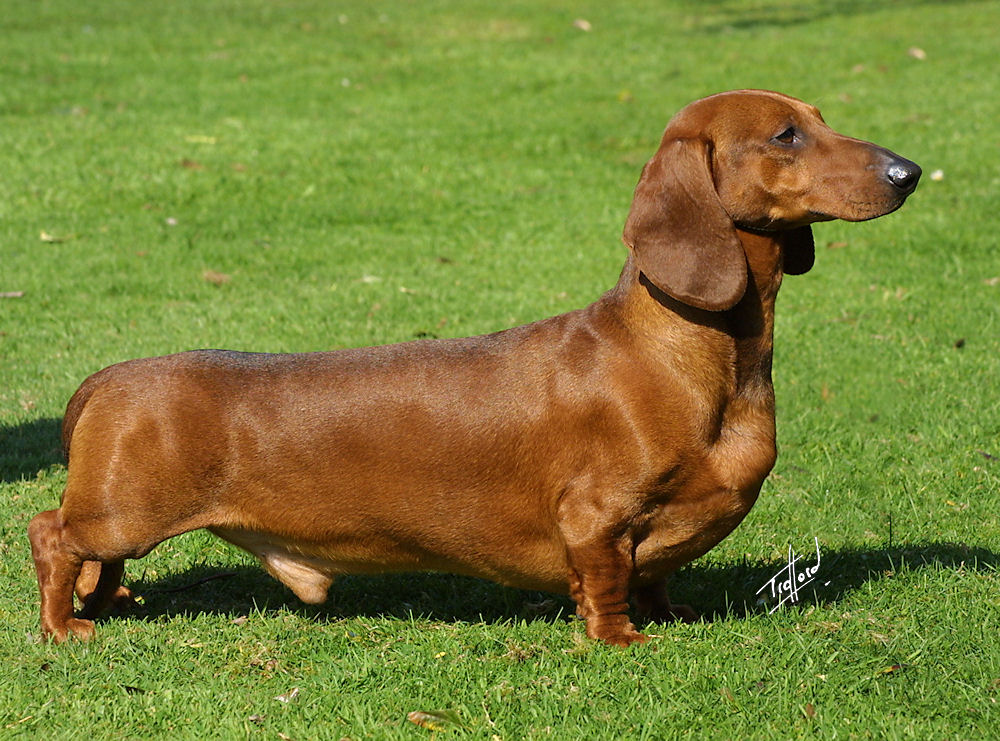
Photo: Wikimedia Commons
Origin
Germany
Lifespan
12–16 years
Weight
7–14.5 kg (15–32 lbs)
Height
20–27 cm (8–9 in)
Exercise
30 to 60 min/day
Diet
Omnivore — weight management critical; small-breed kibble fed on a strict schedule
Taxonomic Hierarchy
Kingdom
Animalia
Phylum
Chordata
Class
Mammalia
Order
Carnivora
Family
Canidae
Genus
Canis
The Story
The Dachshund is one of the most iconic dog silhouettes in the world — a long body, short legs, and an expression of cheerful determination that has made them a global cultural symbol. Bred in Germany from at least the 15th century to hunt badgers ("Dachs" meaning badger, "Hund" meaning dog), their elongated body was purpose-built to enter badger dens and their large, paddle-shaped paws designed for digging. They come in two sizes (standard and miniature) and three coat types (smooth, wirehaired, and longhaired). They are the most popular hound breed in most Western countries and one of the most recognisable breeds on Earth.
Also Known As
Quick Facts
Discover which pets match your lifestyle
Physical Profile
Source: wikimedia
The standard Dachshund is characterised by a long, muscular body set low to the ground on very short, but strong, legs. The deep chest houses remarkable lung capacity for a scent hound. The head is long and conical with a slightly arched skull, elongated muzzle, and pendulous ears. The smooth coat type has a short, shiny coat; the longhaired type has silky, slightly wavy hair with feathering; the wirehaired type has a short, thick, rough outer coat with bushy eyebrows and beard. Colours are diverse — solid red is most common, with black and tan, chocolate and tan, dapple, and brindle all recognised.
Grooming
Low
Shedding
Moderate
Brushing
1-2x-Weekly
Bathing
Every-6-8-Weeks
Coat Colors
Recognized By
Source: wikimedia
Temperament & Personality
Dachshunds have personality in excess relative to their size. They are bold, curious, and remarkably tenacious — a direct inheritance from their badger-hunting ancestry, which required a dog willing to confront an animal three times its size underground. They are fiercely loyal and often bond intensely with one person, while remaining friendly with family. Their independence and stubbornness can make training challenging — they are not naturally biddable dogs. They are alert and vocal, making excellent (if occasionally over-enthusiastic) watchdogs. Their hunting instinct means they dig, follow scents, and pursue small animals with enthusiasm.
Personality Scores
Adaptability
4/5Attention Need
4/5Friendliness
3/5Playfulness
4/5Protectiveness
3/5Living Profile
Ideal Space
Apartment
Daily Exercise
30 to 60 min/day
Ideal Weather
5°C to 28°C
Cognitive Benchmarks
Adaptability
40%
Attention
40%
Playfulness
40%
Communication Style
Stress Signals
excessive barking, digging, aggression (fear-based), back pain symptoms, appetite changes
Care & Wellness
Professional Care Protocol
- •Dachshunds are vulnerable to back injuries due to their chondrodystrophic conformation — ramps rather than stairs, avoiding jumping on/off furniture, and no rough play are important lifelong precautions. Weight management is critical as excess weight dramatically increases spinal stress. Daily exercise through leash walks and play is important, but jumping and twisting activities should be avoided. The smooth coat needs minimal grooming; longhaired and wirehaired coats need more attention. Teeth should be brushed regularly — dental disease is common in the breed.
Nutrition Notes
Weight management is CRITICAL — every extra kilo dramatically increases IVDD risk. Keep at lean body condition. Joint supplements from age 2. Avoid foods that cause weight gain. Feed measured meals only.
Vaccination Schedule
Vaccination Schedule
Senior Care
IVDD (intervertebral disc disease) is the defining breed health issue — 1 in 4 Dachshunds will have a disc episode. Ramps mandatory (no jumping on/off furniture). If sudden paralysis occurs, emergency surgery within 24-48 hours gives best outcomes. Obesity is the #1 preventable risk factor.
Wellbeing Activities
Nutrition & Sustenance
Daily Calories (Adult)
700 kcal
Daily Calories (Young)
500 kcal
Recommended Foods
Foods to Avoid
Health Overview
Intervertebral Disc Disease (IVDD) is the single most significant health concern in Dachshunds, affecting an estimated 25% of the breed during their lifetime. Their chondrodystrophic conformation means disc material calcifies early and is prone to herniation. Preventing obesity and high-impact activities reduces but does not eliminate risk. Patellar luxation and epilepsy also occur at elevated rates.
Common Conditions
Price Estimates
Pricing Guide
Average estimates as of 2025
Longhair and wirehair varieties sometimes slightly more expensive than smooth. Dapple (merle) pattern popular but double-dapple breeding causes deafness and blindness — avoid. Pet insurance strongly recommended due to IVDD costs (surgery ₹1-3 lakh India, $5,000-10,000 USA).
Purchase Price
$700 to $2,000
Adoption Fee
$75 to $400
Data from 2025
Fun Facts
During World War I, the Dachshund's German origins made the breed so unpopular in Britain and America that the breed was temporarily renamed the "Liberty Dog" or "Badger Dog" by owners wanting to avoid anti-German sentiment.
The Dachshund was the official mascot of the 1972 Munich Olympics — a Dachshund named Waldi was the first-ever Olympic mascot, and the marathon route was designed in the shape of a Dachshund.
Dachshunds have a surprisingly powerful voice for their size — their bark was deliberately developed to be loud enough to alert hunters to their location when they had gone to ground in a burrow.
Genetic studies show the Dachshund's extremely short-legged conformation is caused by a retrogene insertion — a duplicated gene that makes their limb bones produce more oestrogen-like compounds, which signals them to stop growing earlier.
The Dachshund is the only breed officially classified as both a hound and a terrier by some kennel clubs, reflecting its dual role as scent tracker and earth dog.


